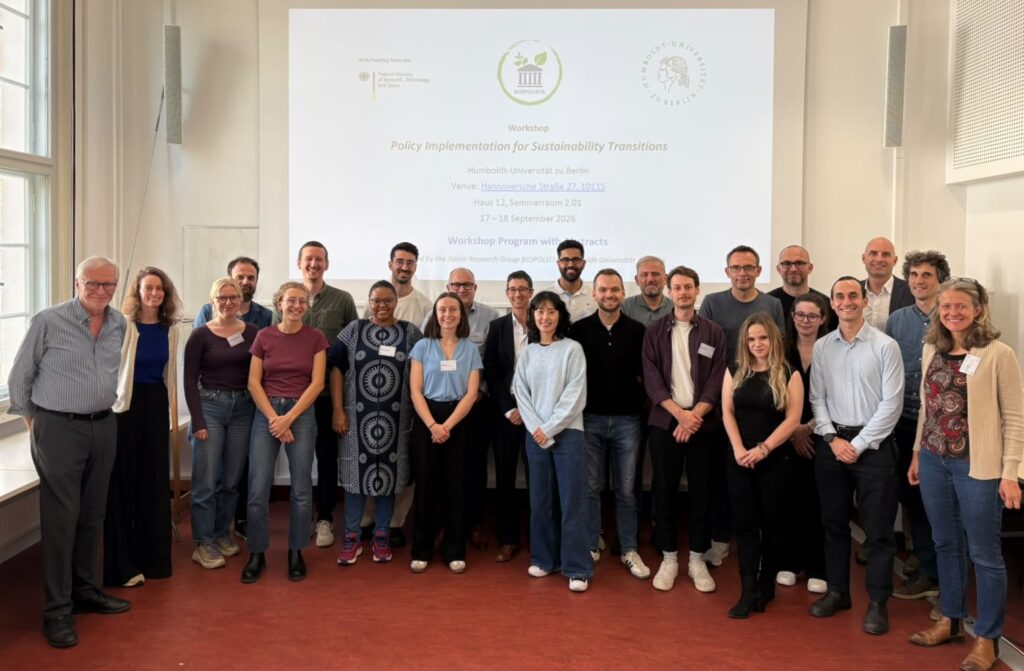
Last week, BIOPOLISTA hosted the workshop “Policy Implementation for Sustainability Transitions” at Humboldt-Universität zu Berlin, bringing together researchers from across Europe and beyond for two days of intensive exchange on the challenges of implementing sustainability policies.
Governments worldwide have adopted ambitious agendas for climate neutrality, green industrial policy and the bioeconomy. Yet, what happens when these policies move from the drafting stage into practice remains an important and understudied question. The workshop focused on this implementation gap, exploring how policies are translated into action by administrations, businesses and communities across different contexts.
Across six sessions, participants discussed a broad range of topics, including how to conceptualise and measure implementation success, the role of politics, institutions and state capacity, mission-oriented and green industrial policy, energy and carbon policy across governance levels, bioeconomy policy implementation, and the implementation of policies affecting land, resources and agri-food systems.
Contributions drew on cases from countries including South Africa, Colombia, Japan, South Korea, Poland and France, and Germany. Bringing together perspectives from different sectors, regions and theoretical traditions highlighted the value of comparative approaches to understanding policy implementation and the conditions that shape its outcomes.
The workshop was organised by the Junior Research Group BIOPOLISTA and funded by the Federal Ministry for Research, Technology and Space (BMFTR). We would like to thank all presenters and discussants for their insightful contributions and constructive feedback, as well as our research assistants Zoe V. and Mariia Dziubynska and BIOPOLISTA colleague Giorgio Varanini for their extensive work in organising and coordinating the workshop.